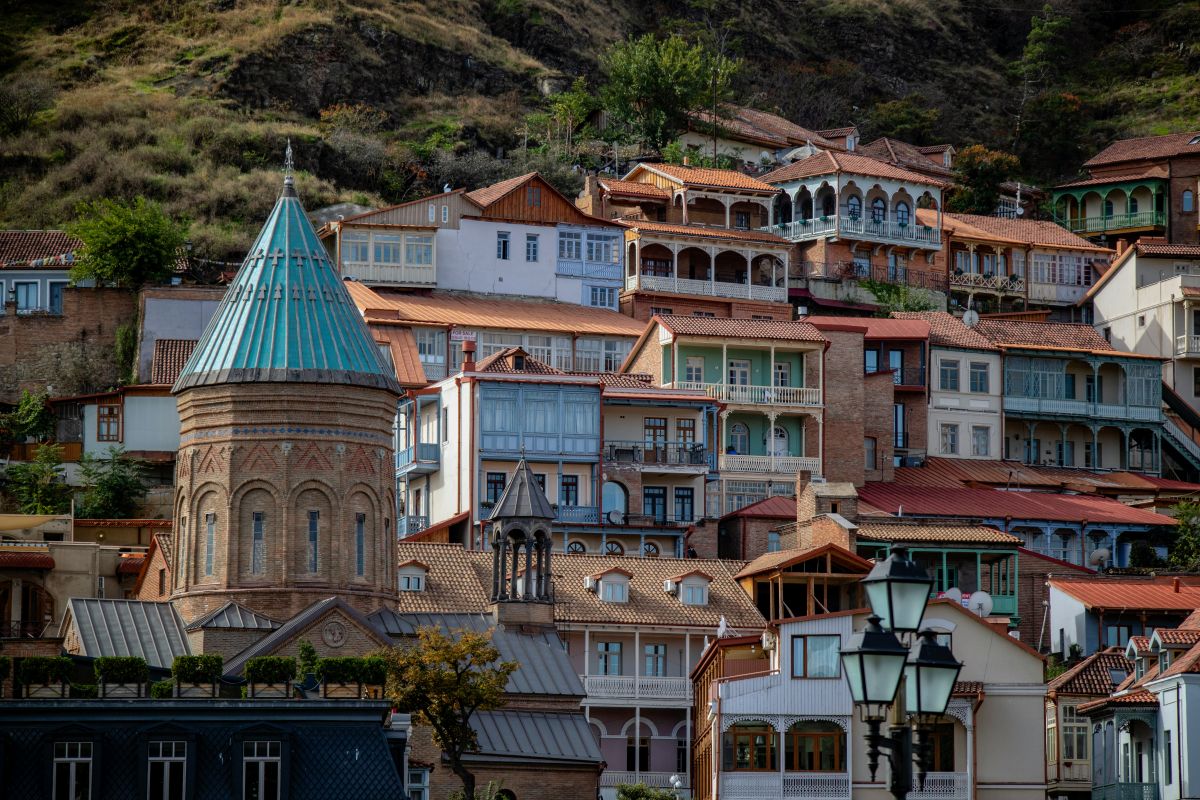
When we landed in Tbilisi, more than the airport, it was the drive into the city that caught my attention.
Instead of crowded highways and concrete skylines, the road wound through hills, rivers, and wide open views. In that moment, I had a feeling that this city was going to be special. I was right!
For Indian travellers who’ve long dreamed of Europe but held back because of visas or budgets, Tbilisi feels like a hidden shortcut.
Think cobblestone streets, wooden balconies, centuries-old churches, wine bars, and rooftop cafés, only at a fraction of what you’d spend in Paris or Prague.
| Best time to visit | April–June and September–October |
| Days needed | 2 full days minimum |
| Currency | Georgian Lari (GEL) — carry USD to exchange |
| Getting around | Walkable city centre, Bolt and metro works well |
| Ideal for | Honeymoon Couples, first-time visitors to Georgia, |
Here’s everything you need to plan two days in Tbilisi.
Planning a trip to Georgia? Read our 10-day Georgia itinerary with honest experiences.
First Impressions: What Tbilisi Actually Feels Like
The city blends old and new in a non-forceful way, like everything here was meant to be. Formally a part of the USSR, we could see Soviet-era apartment blocks sitting right next to restored 19th-century townhouses, and futuristic glass buildings look out over pine-covered hills.
Tbilisi is also remarkably walkable for a capital city.
We spent most of our time on foot, which I think is genuinely the best way to experience it.
One thing that stood out immediately for me was: it felt very safe. As a couple exploring largely on foot and in the evenings, we never felt uncomfortable or out of place.
Locals were super friendly, and the city has a relaxed, unhurried energy that’s rare in capital cities. At night, the cities were lit with amber soft light, which further gave them a soft, cozy feel.
Places to Visit in Tbilisi: 2 Day Travel Itinerary
Depending on where you stay in the city, you can start with the Peace Bridge or Old Town.
| Day 1 | Day 2 |
|---|---|
| Peace Bridge and Rike Park | Rustaveli Avenue |
| Holy Trinity Church | Mtatsminda Park (Funicular) |
| Old Town walk and puppet show | Narikala Fortress cable car |
| Sulphur baths (Abanotubani) | Fabrika Square evening |
| Bridge of Love | Old Town Dinner |
Peace Bridge & Rike Park
We visited the Peace Bridge on the first day, considering it is a short visit. Situated right in the middle of the city, above the river Mtkvari, it is made entirely of glass with a hooded structure at the top that looks like the inside of a reptile’s mouth.
It was just for the pedestrians and had stairs on both ends for tourists to climb atop.
It was unique and beautiful, but nothing to spend more than 10 min at. However, if you visit it during the night, it is illuminated by several LED lights, which is a sight to behold.
Adjacent to the Peace Bridge is the very famous Metekhi Church, a 5th-century cliff-edge church overlooking the river and one of the most photographed spots in Tbilisi
You can also find the statue of King Vakhtang Gorgasali on his horse, facing towards the sea, giving a panoramic view of its features.
It would be best to visit both of them during early morning or evening, as afternoons can get considerably hot.
Holy Trinity Church
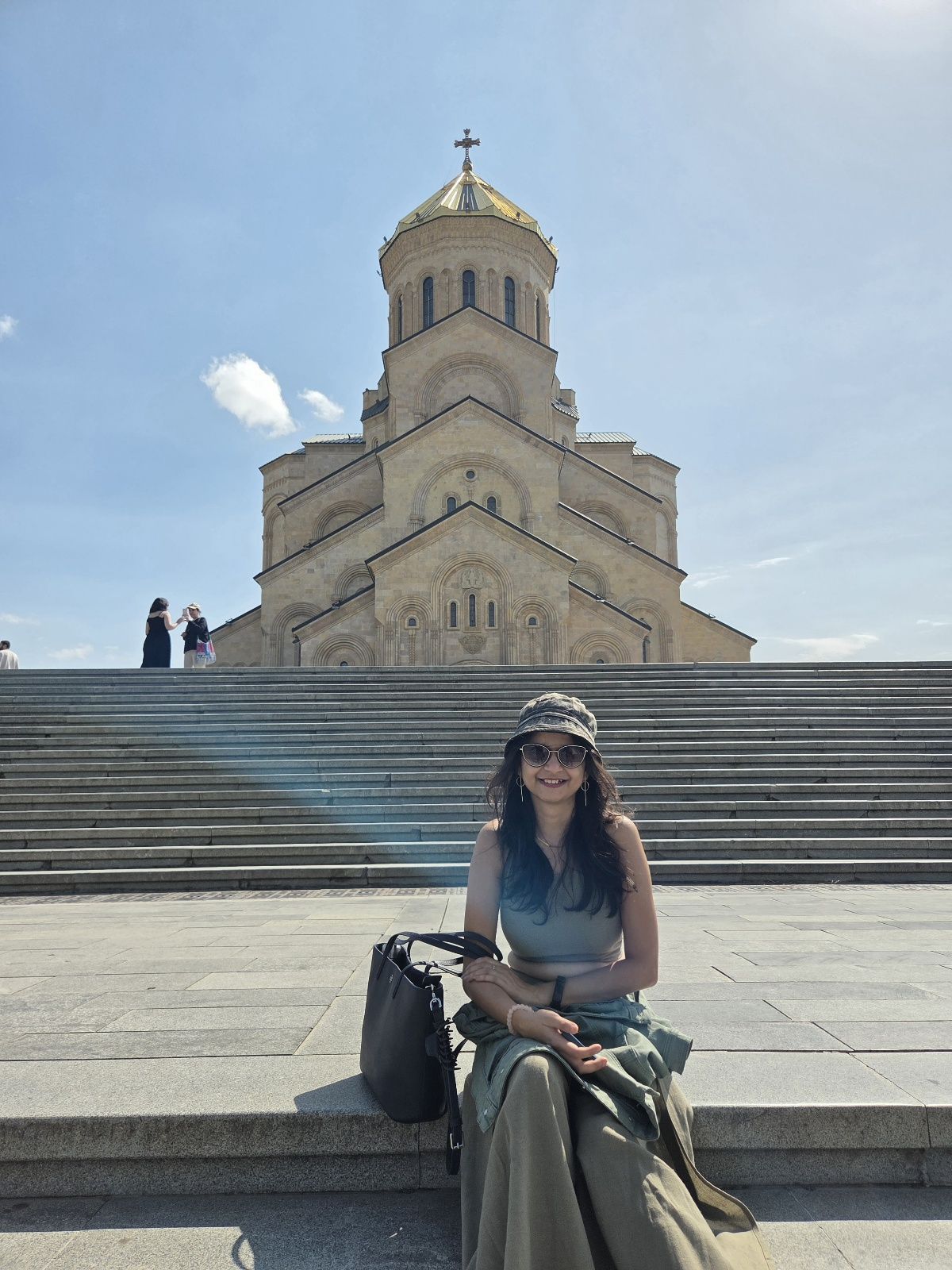
If there is one place in Tbilisi that has my heart, it is the Holy Trinity Church. Located at the center of the city, it’s a magnificent example of traditional Georgian Orthodox architecture.
While there are many churches and monasteries all across the country, this stands out for its symmetrical, magnificent structure and golden dome that shines like a star.
We went early in the morning and found it to be deserted, which worked in our favour because we got amazing pictures.

There was a different atmosphere inside the church. Taking pictures is not allowed. While some tourists tried clicking secretly, it was not appreciated by the priest and locals.
You enter into a high ceiling with stained glass windows, and the main altar with a high chair kept directly opposite it.
There were also various frames on the walls depicting scenes from the Bible, and a tall sand holder to place the incense sticks
I absolutely loved the experience of witnessing the peaceful interior and opulent exterior.
Pro tip: You are not supposed to enter the churches in Georgia with bare head, arms, or legs. So either you can wear fully covered clothes, which honestly could be an issue if you travel during summer, or you can carry a jacket, scarf, and a sarong to cover them.
You will need them all throughout the trip whenever you visit churches or monasteries.
Old Town Tbilisi
The old town area is the most special part of the city, which contains in itself all its charm and vintage beauty.
We spent a full afternoon just wandering here with no fixed plan, which turned out to be the right approach.
There were houses, restaurants, small shops, and food stalls. There was also an uphill road that snaked between cute, colorful houses and cafes.
It was definitely an area that you can enjoy when you explore slowly.
Jansugh Kakhidze Street
Also called Jan Shardeni Street locally, it is the most popular pedestrian street in the old town, lined with restaurants and cafés.
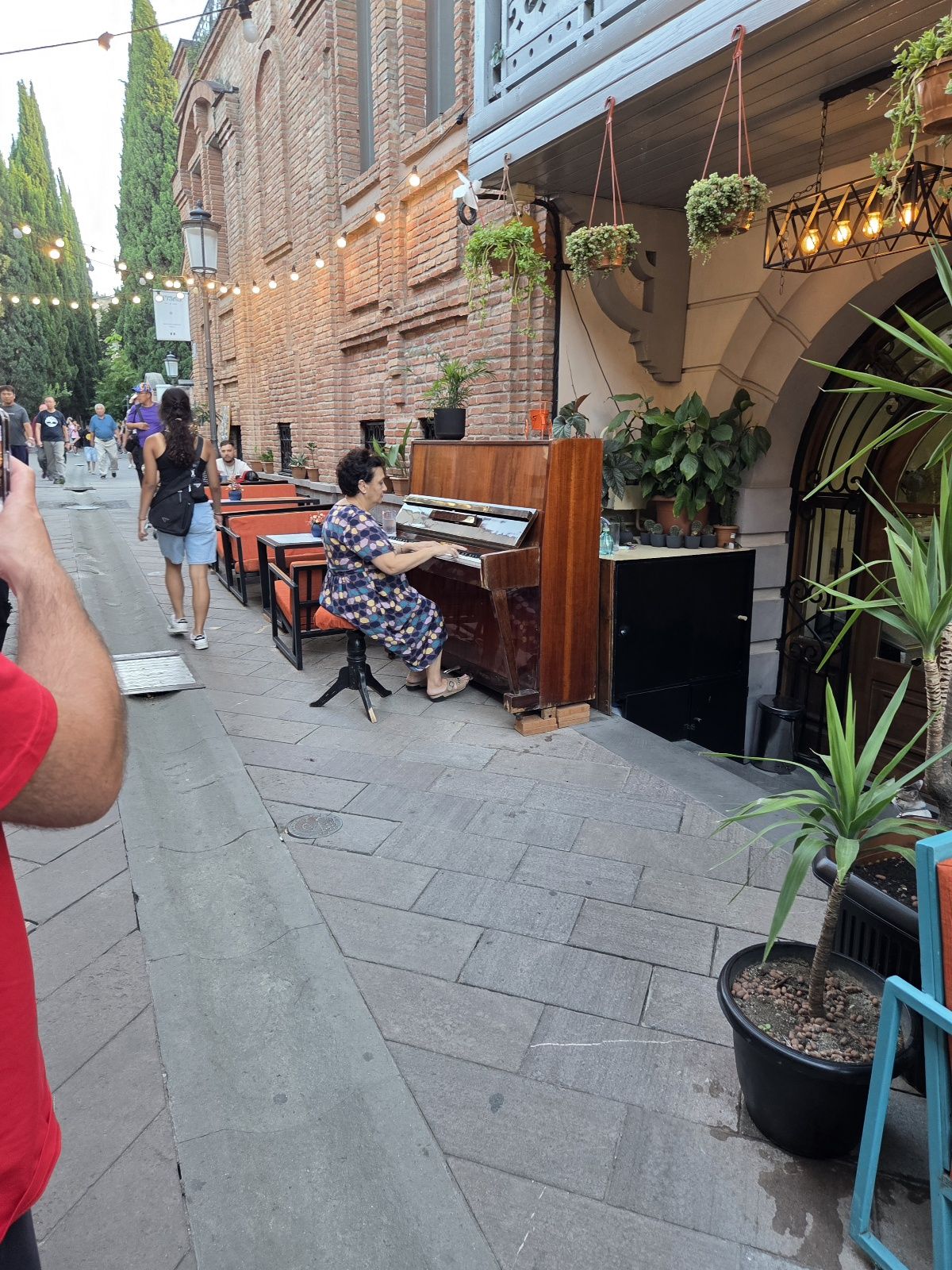
It gets busy in the evenings and has a lively, almost festive atmosphere. Worth a walk through, though it’s more tourist-facing than the quieter lanes around it.
Puppet Show
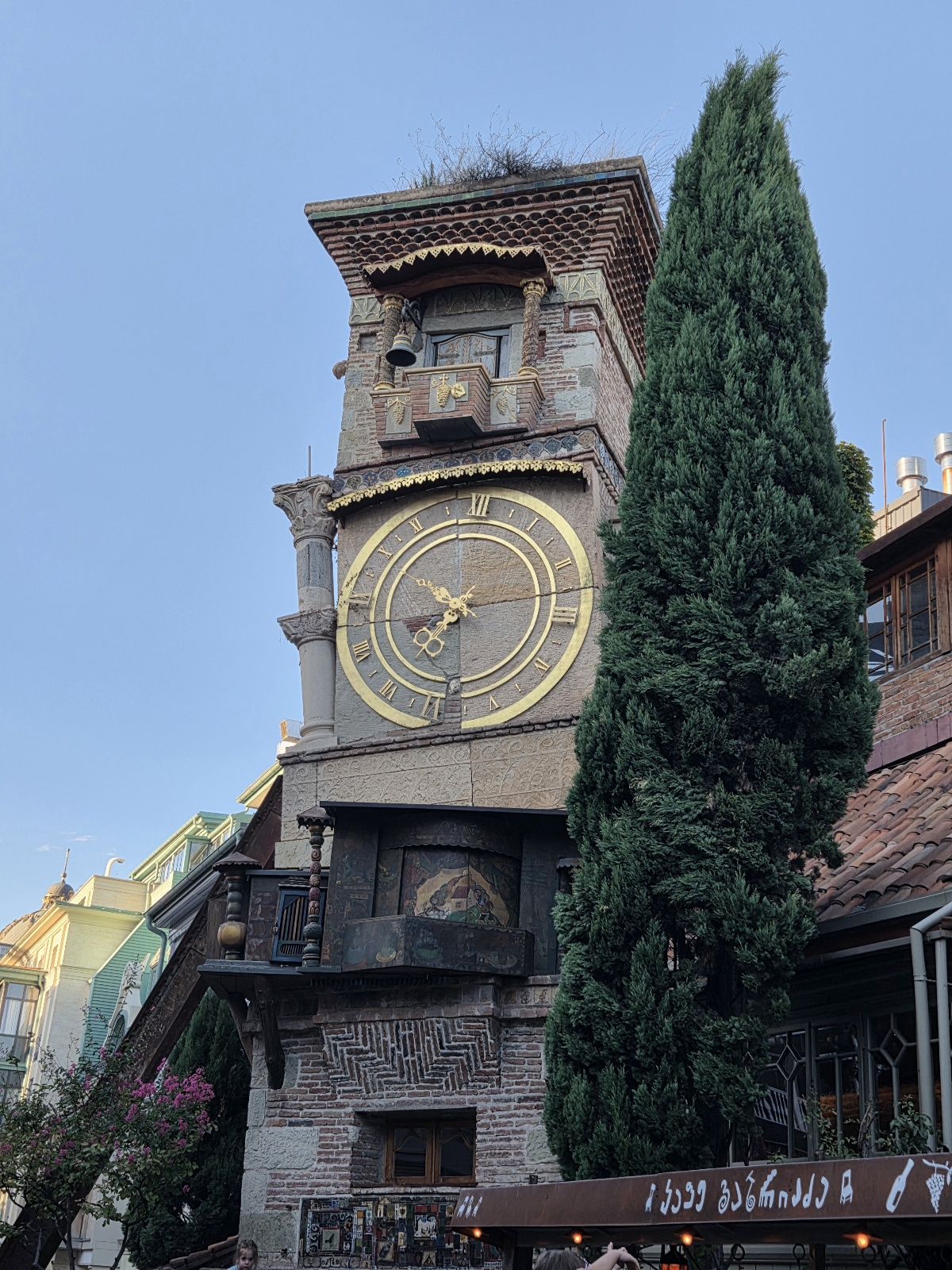
On walking 10 min from the Shardeni Street, you can find the Gabriadze Theater, which hosts a century-old, hourly puppet show, unique for its vintage feel.
It is a very vintage, charming setup where an angel emerges out of the tiny door at the top of the tower and rings a bell. There is also a whole miniature performance twice a day at 12:00 and 19:00.
After the show was done, a man standing around all this while, handed over a brown sheet of paper, which was actually a one-page Tbilisi fact book with our photo in the middle, the best souvenir we got to bring back.
Quick tip: Morning is the best time to walk the old town before the crowds arrive, if you want to take pictures. Evenings are lively, but the lanes get busy. If you want photos without people, go before 9 am.
The old town area has its own personality. So, ensure to explore it on foot as much as you can. However, if you are confused about where to start or looking for a guided tour, here’s a good tour you can book.
Sulphur Baths: The Experience No One Prepares You For

If you like experiences, the sulphur baths are a must-visit.
The baths, located in the basement, use natural geothermal water that has been flowing under Tbilisi for centuries. According to local legend, the discovery of these hot springs led to the city’s founding here in the 5th century.
There are many sulphur baths in the city, but the most famous is in the Abanotubani district.
The most photographed one, the Chreli Abano, also known as Orbeliani Baths, is a beautifully tiled building that looks more like a mosque than a spa. Even if you don’t go inside, the exterior is worth stopping for.
The district is easy to spot: it’s the area with distinctive dome-shaped structures that look as if they were lifted from Persia or Turkey.
The Sulphur Bath Experience
You can choose between a public pool and a private room. For couples, the private room is worth the extra cost; you get a room to yourselves with a large bath, towels, and a scrub-down service if you want it. Prices for a private room start at approximately 40–80 GEL per hour, depending on the bathhouse and the day.
You would have to pay an extra 5 and 10 GEL if you take a scrubbing glove and a towel.
Budget approximately 60–100 GEL per couple for a private room with a scrub and towels.
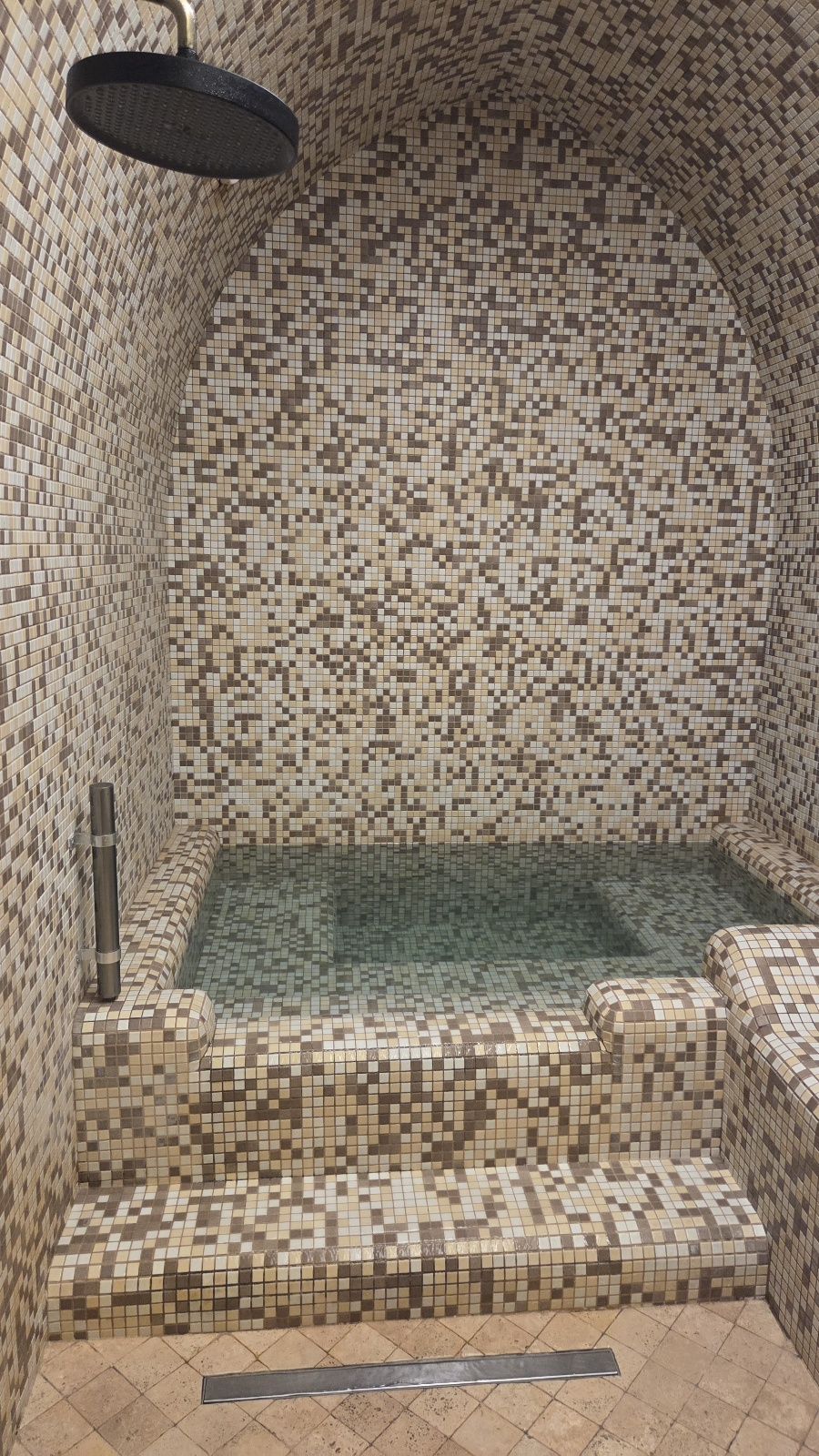
The water has a distinct sulphur smell (imagine the smell of boiled eggs), though significantly less overwhelming than that sounds.
Your body adjusts within a few minutes, and then it just feels like an unusually warm, slightly mineral-rich bath. it is known to soften and cleanse your skin.
You spend 20 min submerged in the pool containing a sulphur bath, after which same-gender Mekise (attendants) enter the room to give you a Kisa scrub with the scrubbing glove you bought while billing. After the scrub, they would also apply soap through a cotton bag and ask you to wash off.
(To understand how it transpires, I would suggest you watch this docu-series by Phil Rosenthal called Somebody Feed Phil (Season 8, Ep 4) on Netflix.)
So for experience, you must do it. Book a luxury, private bath experience here.
The Cherli Abano Sulphur bath and many others situated in the old Town are beautiful but expensive.
A budget-friendly option is the Kyiv Sulfur bath at 4 Kyiv Street, which my friend recommended.
Is it Worth it?
Yes, especially for couples. It’s an unusual experience that you can’t replicate anywhere in India and could be a once-in-a-lifetime experience.
While I am glad I indulged in the experience, I didn’t love it due to its intense smell.
At the end of the bath, I felt a headache coming, and it didn’t feel like it did anything much to my skin. Although my partner was okay with the process.
Narikala Fortress and the Cable Car

Similar to the King of Georgia, the Mother of Georgia statue is situated at Narikala Fortress, giving an entire city view.
Narikala is a 4th-century fortress now mostly in ruins, but the hilltop it sits on gives you a 360-degree view of the city — the river winding through it, the old town rooftops, the modern glass bridge, and the mountains visible in the distance on clear days.
The Mother of Georgia statue is right here; a 20-metre aluminium figure of a woman holding a sword in one hand and a bowl of wine in the other. The sword is for enemies. The wine is for guests. It’s a very Georgian way of introducing yourself.
To reach it, you will need to take the cable car from Rike Park up to Narikala Fortress. The ride takes about five minutes and costs 5 GEL per person, payable via a MetroMoney card or cash. (You can top one up at the cable car station).
While it was amazing to look at the view from the top, it was not worth it, considering the heat and time it took us to take the cable car and reach the top. But if the temperature is good and you don’t have to wait more than 5-10 min to take the cable car, you can give it a try to take pictures with the Mother of the Statue in the background.
If you only want to ride up for the view, you can get a better panoramic view from the Mtatsminda Park.
Pro tip: The cable car runs from approximately 8 am to 8 pm, but it can be closed in high winds. Check before making the trip up; we heard from other travellers that it closed for a day during our visit due to the weather.
You might like: Packing essentials for Indians travelling abroad
Fabrika Square: Tbilisi’s Creative Corner
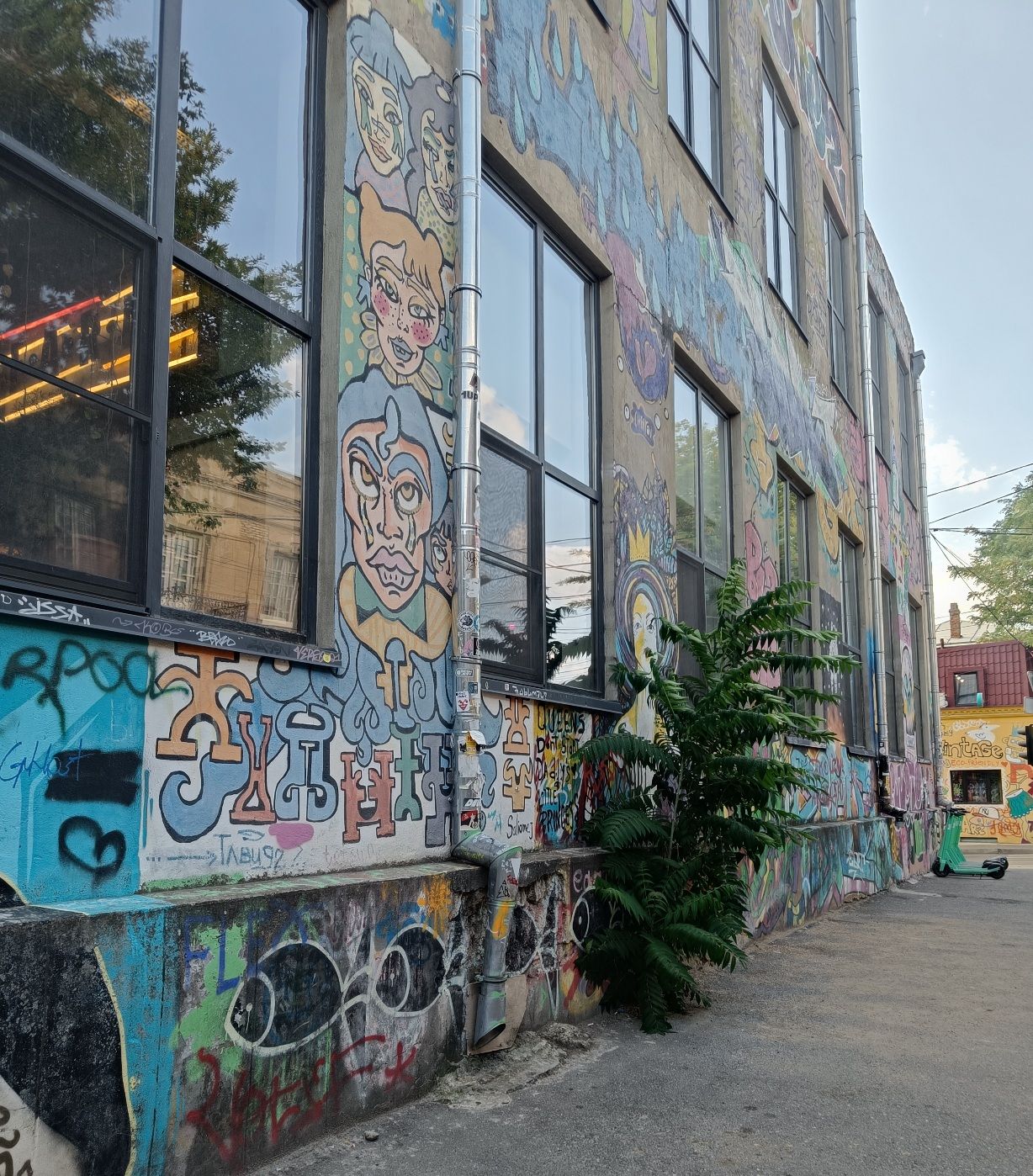
Having searched about it while planning Tbilisi, I was highly excited for Fabrica Square, and thankfully, it didn’t disappoint.
It’s a converted Soviet-era sewing factory turned into a creative hub. It has co-working space, hostels, concept stores, food stalls, and a courtyard that fills up with young locals and travellers every evening.
It has a distinctly non-touristy energy despite being popular with visitors. The courtyard especially feels like a place Tbilisi residents actually use, with people sitting on the grass, small live music setups, and a place of informal gathering. We spent some time there, sipping on a berry Mojito and just enjoying the vibe. It had graffiti on all its walls, with people hanging out casually.
We found it a good place to spend an evening, cheaper than the restaurants in the old town, more atmospheric than a hotel bar, and excellent for people-watching.
Rustaveli Avenue: The Heartbeat of the City
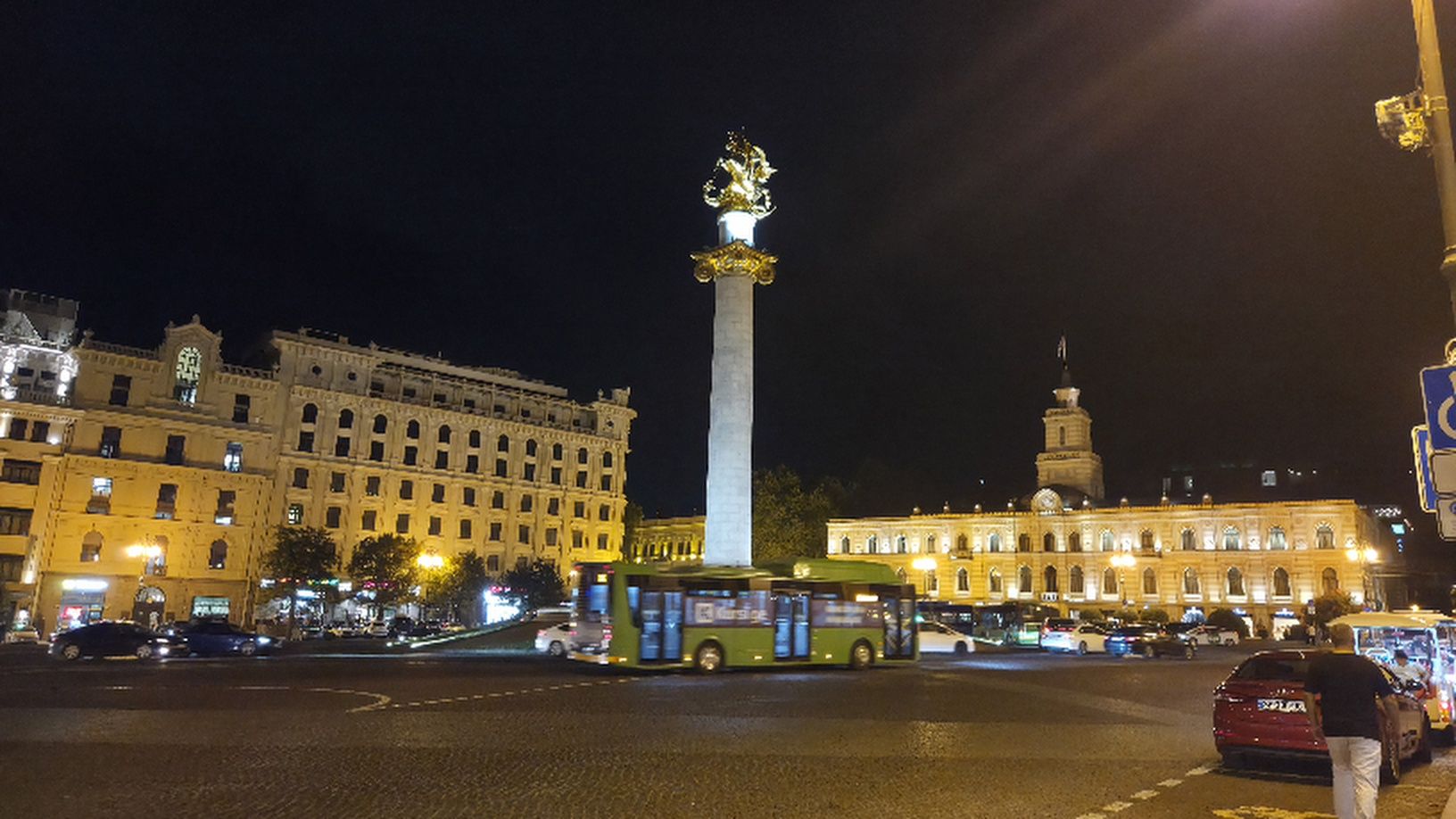
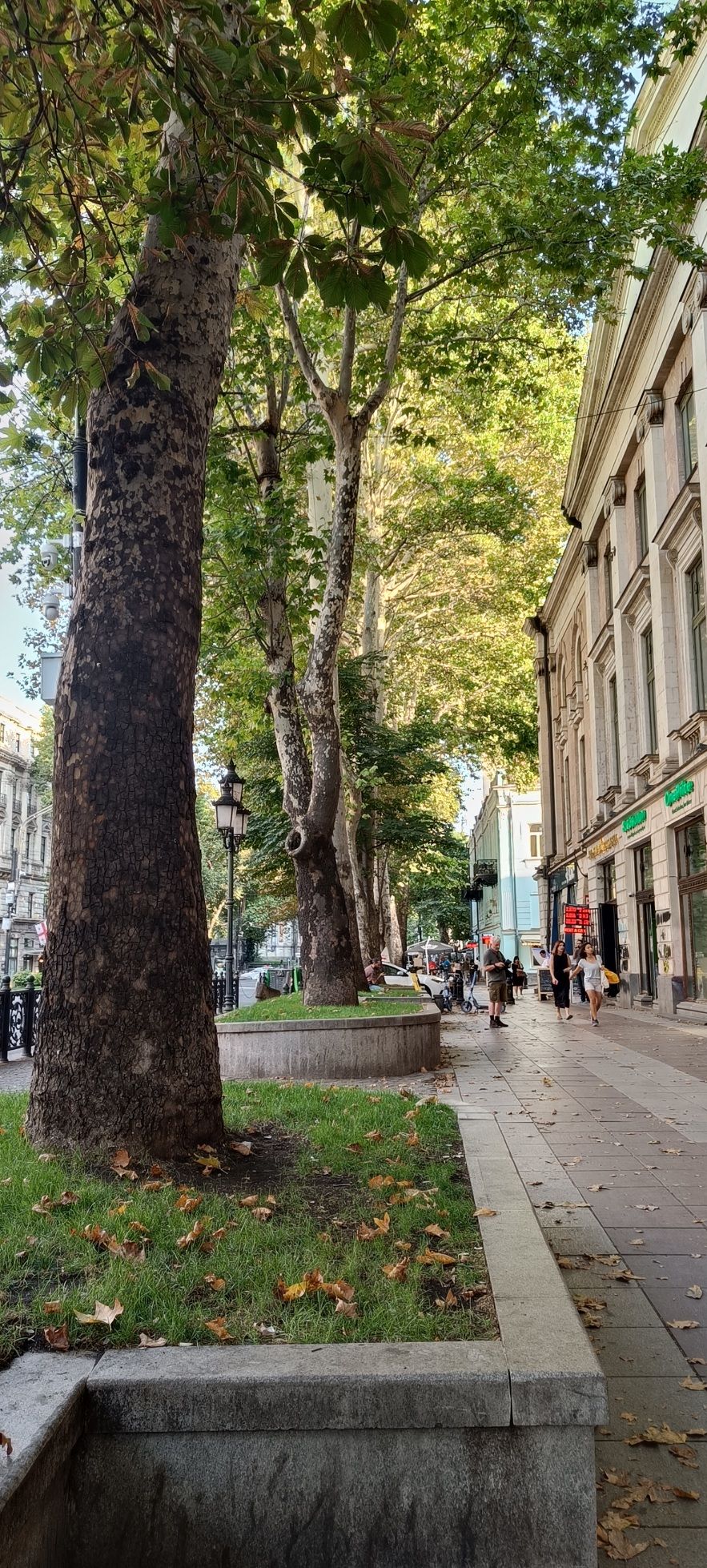
Rustaveli Avenue is Tbilisi’s main boulevard with wide, tree-lined roads, flanked by some of the city’s most impressive buildings. The Georgian National Museum, the Opera House, the Parliament building, and several grand hotels all sit along this stretch.
It was an amazing experience walking the full length as it felt like the heartbeat of the city, like you would call Times Square of New York or India Gate of New Delhi.
We visited the avenue multiple times during our 4-day stay, once to visit the mall -Galleria Tbilisi, and other times to just stroll around the area.
The area was always lively with street vendors selling books and small paintings, flower stalls, souvenir vendors, and local families out for an evening walk. It looked like a roadside mini market sort of thing with shops ranging from currency exchange, cafes, souvenir shops, etc.

In the main square, there is a huge marble column with a statue of a man riding the Peagus. While it looked ordinary in the day, during the night, when the street was lit, it looked magnificent.
We also found a very cute cafe in one of the alleys of the avenue run by a young lady. The basement cafe was owned and run by the lady, and the food was really good.
Mtatsminda Park through Funicular
Another attraction in Tbilisi that I thoroughly enjoyed was the Mtatsminda Park. You need to take a Funicular ride to reach the top, which was itself an experience.
The entry fee to the park and the funicular totaled up to 55 Lari, and you can buy tickets in the small office at the gate. A funicular is a cable car that runs from the bottom to the top in a diagonal route rather than parallel, as other cable cars do.
It stops midway to deboard tourists who want to visit the Pantheon ( we skipped) while it is precariously tilted sideways. Once it reaches the top, you are free to roam around, visit the amusement park, have food, shop at the stalls, play fair games, and witness the spectacular view of the entire city.
I could visit it again just for the view and the ride. If you are visiting with your family, you must definitely add this to your Tbilisi itinerary.
Pro tip: The food was a bit expensive on top. If possible, take some snacks and water with you.
Bridge of Love
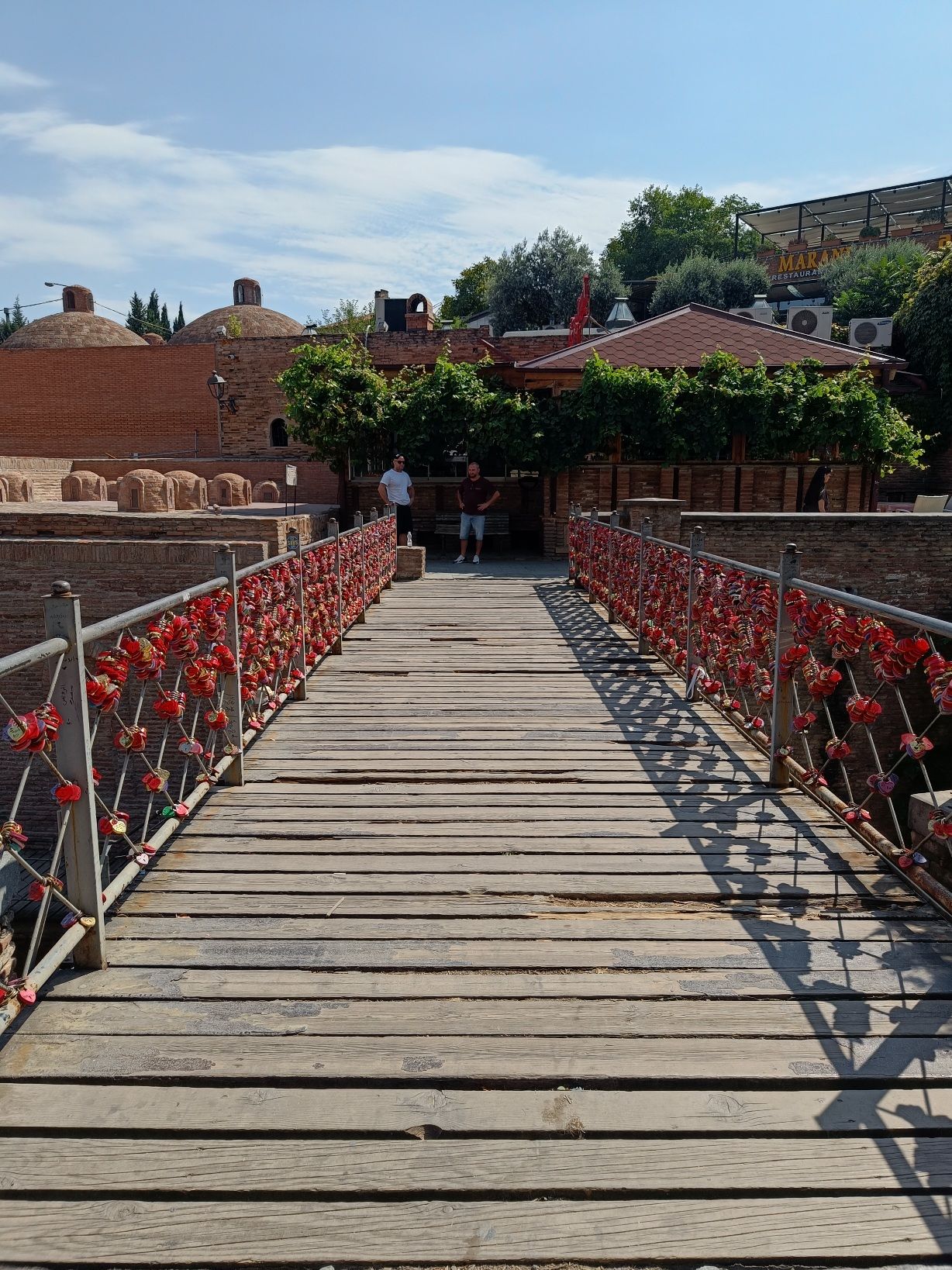
Nestled in the old town, amidst the hill, is the small stretch of the Bridge of Love.
It is a glass pedestrian bridge that crosses the Kura River, lit up at night and surrounded by padlocks left by couples from all over the world.
If you’ve seen love lock bridges in Paris or other European cities, this is Tbilisi’s version, though the glass structure itself is more architecturally interesting than most.
It felt worth a walk across, during the day, for its vibrancy and pictures.
Pro tip: You can add your own padlock to the bridge. We felt it was expensive at 150 GEL and skipped it.
Keep your evenings free to roam around the Old Town area. You can have dinner at one of the cafes as well
Food in Tbilisi: What to Eat (Including Good Options for Vegetarians)
Georgian cuisine is meat-heavy, but Tbilisi is more accommodating for vegetarians than most people expect, particularly if you know what to look for.
Khachapuri or Georgian pizza is non-negotiable. It’s a cheese-filled bread that comes in several regional variations. The Adjarian version, a boat-shaped bread with an egg cracked on top, is the most famous and the most indulgent. It’s eggatarian and genuinely delicious.
Lobiani is a kidney bean-filled bread that tastes remarkably similar to a stuffed paratha. If you’re a vegetarian and missing Indian food comfort, this is your answer in Tbilisi.
Pkhali is a cold starter made from spinach, walnuts, and garlic, different from anything in Indian cuisine but deeply good.
Lobio is a spiced bean stew served with bread. We found it closest in spirit to rajma, but with a flavour profile all its own.
Khinkali is a hand pleated dumplings stuffed with spiced minced meat. A must try for non-vegetarians.
Churchkhela is a traditional, candle-shaped, brittle sweet candy. It is made with nuts and fruit juices like grape or pomegranate.
Instead of having a sit-down meal, we mostly had our meals in cafes and restaurants while roaming the city. I loved the vegetarian Kebab roll from TbilisIstanbul Restaurant Cafe at Abano St.

We also found a small, cute cafe at one of the alleys in Rustaveli Avenue, run by a young lady. We tasted the authentic Georgian Vodka cha cha and hot dog, which was delicious.
There were several Indian restaurants as well throughout the city. However, they were priced much higher than normal Georgian food.
We tasted Lobio, lobiani, and Khachapuri and found them to be delicious. Additionally, we also brought back Churchkhala for our friends and families.
For vegetarians specifically: Look for restaurants that list pkhali, lobiani or badrijani (aubergine rolls with walnut paste) on the menu; these signal a kitchen that will have vegetarian food.
Pro Tip: The restaurants in Georgia typically use egg in the pasta batter. Enquire before you order a pasta from the menu if you don’t eat eggs.
You can order home delivery for food with apps like Wolt or Glovo.
Planning your full Georgia trip? Here’s our 10-day Georgia itinerary
Getting Around Tbilisi
Tbilisi is more manageable than it looks on a map. The old town, Abanotubani, Fabrika, Rustaveli Avenue, and the cable car to Narikala are all within walking distance of each other if you’re comfortable with hills.
For longer distances within the city, Bolt is the cab service provider. You can download the app and book rides whenever. Thankfully, it is inexpensive as well; most rides within the centre cost 5–10 GEL.
If you want, you can also explore the metro, which is functional and cheap (1 GEL per ride with a MetroMoney card), though the old town area isn’t directly served by it.
Pro Tip: Avoid booking taxis through hotel concierges; the rates are significantly higher than Bolt for the same distance.
In case you are in Tbilisi for a short period, you can book this tour for major sightseeing.
Where to Stay in Tbilisi

Tbilisi has accommodation across every price range, from party hostels in Fabrika to boutique hotels in the old town.
For couples looking for atmosphere over party vibes, the old town area is the best base, you’re walking distance from the sulphur baths, the fortress cable car, and the main sights.
You can expect to pay approximately ₹3,000–8,000 per night for a decent mid-range hotel.
We stayed at a 3-star budget hotel to spend maximum time exploring the city. Called the Ibis Tbilisi Stadium, it was walking distance to major markets and the new town area and a comfortable stay (Check rates here).
If you plan to stay here, do note that it is managed by students and has a self-service policy. There are no bellboys to carry the luggage. However, its restaurant was good, and it had various indoor games, books, and a PlayStation for entertainment.
Practical Tbilisi Information & Tips
Currency: Georgian Lari (GEL). The best exchange rates in Tbilisi are at the small exchange kiosks in the city — specifically around Liberty Square and Rustaveli Avenue — not at the airport. Carry USD or EUR as these currencies exchange best.
Visa: Indian citizens need an e-visa for Georgia. Apply at evisa.gov.ge before travel. If you hold a valid US, UK, or Schengen visa, you can enter Georgia visa-free.
Safety: Tbilisi is genuinely safe for Indian couples. We had no concerns walking around at any time of day. Basic common sense applies as it would anywhere.
Language: Georgian script is one of the most distinct writing systems in the world — you will not be able to read a single word of it. Most people working in tourism and restaurants in Tbilisi speak enough English to manage. Google Translate works for everything else.
Best time: April to June and September to October are the most pleasant months. Summers get warm — not unbearably so, but worth knowing.
Is Tbilisi Worth Visiting?
For Indian travellers who want Europe’s charm without Europe’s cost or visa headaches, Tbilisi is the best option. It genuinely surprises you in so many ways.
Give it two full days. Walk the old town slowly, do the sulphur bath, eat khachapuri somewhere with locals rather than tourists, and take the cable car up at sunset. That’s all you need to understand why Tbilisi keeps showing up on lists of Europe’s most underrated cities.
Planning your full Georgia trip? Here’s the 10-day itinerary we followed.
Questions You Might Have
How many days is enough for Tbilisi?
Two full days are enough to see the main sights without rushing. Three days allow you to slow down and explore more neighbourhoods.
Is Tbilisi good for vegetarians? Is Indian food available in Tbilisi?
More than you’d expect. Khachapuri, lobiani, pkhali, and lobio are all vegetarian and genuinely good. Most restaurants in the old town area have English menus. You can also find some Indian restaurants.
How much does it cost to visit Tbilisi per day?
On a mid-range budget, expect to spend approximately 100–150 GEL (₹2,500–4,000) per day per couple covering food, transport, and one or two activities. Accommodation is additional.
Is Tbilisi safe for couples?
Yes. It’s one of the safest capital cities we’ve been to. The city has a relaxed, welcoming atmosphere, and tourists are a normal part of daily life here.
Discover more from The Hopping Tales Journal
Subscribe to get the latest posts sent to your email.
Leave a Reply