| Location | Kvareli, Kakheti region, Georgia |
| Distance from Telavi | ~30 minutes by car |
| Distance from Tbilisi | ~2.5 hours by car |
| Options available | Tunnel tour (10 GEL), Wine tasting (35 GEL), Grape stomping (50 GEL) |
| Best time to visit | September–October for harvest season |
| Book in advance? | Yes, especially October |
| Ideal for | Couples, non-drinkers welcome |
Winery Khareba in Kakheti is one of the most famous wine‑tasting experiences in Georgia, and it’s worth visiting even if you don’t drink.
I am not a wine drinker; in fact, I am a teetotaller.
So visiting a winery should not make sense for me. But it did, and while I did not expect the winery to be the highlight of my Kakheti trip, it turned out to be exactly that.
Kakheti is known for its wine, and so doing a wine tasting was a must, or so we were told.
But after a full day of visiting Sighnaghi and nearby spots in extreme heat, the visit to the winery gave me joy that remained the best part of my entire trip.
Here’s the experience of a winery visit in Kakheti, Georgia. ( Explore other places to visit in Telavi, Kakheti, in this detailed blog.)
- Where is Winery Khareba, And How to Get There?
- Khareba Wine Tunnel Experience
- The Wine Tunnel: Better Than Expected
- The Vineyard: Harder Than It Looks
- The Grape Stomping: The Moment the Whole Trip Was Worth It
- Practical Information: Everything You Need to Know About Winery Khareba
- Is Winery Khareba Worth It?
- Questions About Winery Khareba
- How much does Winery Khareba cost?
- Do I need to book Winery Khareba in advance?
- Is Winery Khareba worth it for non-drinkers?
- What is the grape stomping experience like at Winery Khareba?
- How do I get to Winery Khareba from Tbilisi?
- How do I get to Winery Khareba from Telavi?
- What should I wear to Winery Khareba?
- Is the wine at Winery Khareba expensive?
Where is Winery Khareba, And How to Get There?
Winery Khareba is located in Kvareli, in the heart of the Kakheti wine region, approximately 30 minutes from Telavi and about 2.5 hours from Tbilisi by car.
(If you’re flying into Tbilisi first, check out my detailed Tbilisi itinerary )
There are two options to reach the winery Khareba:
You can book a Kakheti tour, which includes a visit to the winery Khareba for wine tasting. These are usually private tours where you can visit a couple of different wineries for wine tasting.
These are two of my recommendations for such tours:
Tbilisi-Kakheti Wine Region Private Day Trip with Tastings – Visit 3 wineries, including the winery Khareba
Authentic Kakheti Wine Tour: Tasting & Sighnaghi Wine Tunnel – Visit 2 wineries and also go for cheese tasting.
However, if you wish to get an experience of grape stomping, you might not be able to do so in such tours.
For that experience, it is best to take a private car. (Check the availability of a private car here)
You can also look for private cabs from apps like Bolt or Yandex Go.
Best for first-timers → Group tour
For experience → private car + stomping
Khareba Wine Tunnel Experience
Before I say anything else, let me be clear about what Winery Khareba is and isn’t.
It is not an intimate, family-run cellar where a grandmother pours you wine in her kitchen. ( For a family-run winery experience, you can book a Kakheti tour like this)
It is a large, well-funded, commercially run operation; one of the most famous wineries in Georgia, with awards, a gift shop, and golf carts to ferry visitors between the entrance and the reception.
If you’re expecting rustic and rough-around-the-edges, this is not that.
If you’re expecting organised, beautiful, and genuinely interesting, this is exactly that.
We arrived at the main gate and were asked to wait. Within a few minutes, a golf cart came to collect us and drove us through the property, past manicured gardens, benches under trees, and the kind of well-tended grounds that signal money invested thoughtfully.
After walking all day around Kakheti, I was not in the mood to walk another km to reach the tunnel, so I was really glad to see the golf cart.
At the reception, a young woman was assigned to us as our guide. She was no older than 22 or 23, spoke excellent English, and gave us three options:
A tunnel tour for 10 GEL,
A wine tasting for 35 GEL,
A grape stomping and wine-making experience for 50 GEL.
The world’s oldest wine is believed to have been found in 8000-year-old jars in Georgia. So, Georgia is the birthplace of wine.
We had already done a wine tasting in South Africa, so we chose the tunnel tour and the grape stomping.
The Wine Tunnel: Better Than Expected
Before we entered, she asked us to pick up fur blankets from large boxes outside the tunnel entrance. I found that a little excessive, considering it was searing hot outside.
Once inside the tunnel, I was glad I picked the blanket.
Just a few steps inside, the temperature dropped, making us aware of the dark tunnel, and I found myself reaching for the blanket.
Honestly, it was hard to believe that the cold was natural and not produced by any appliances.
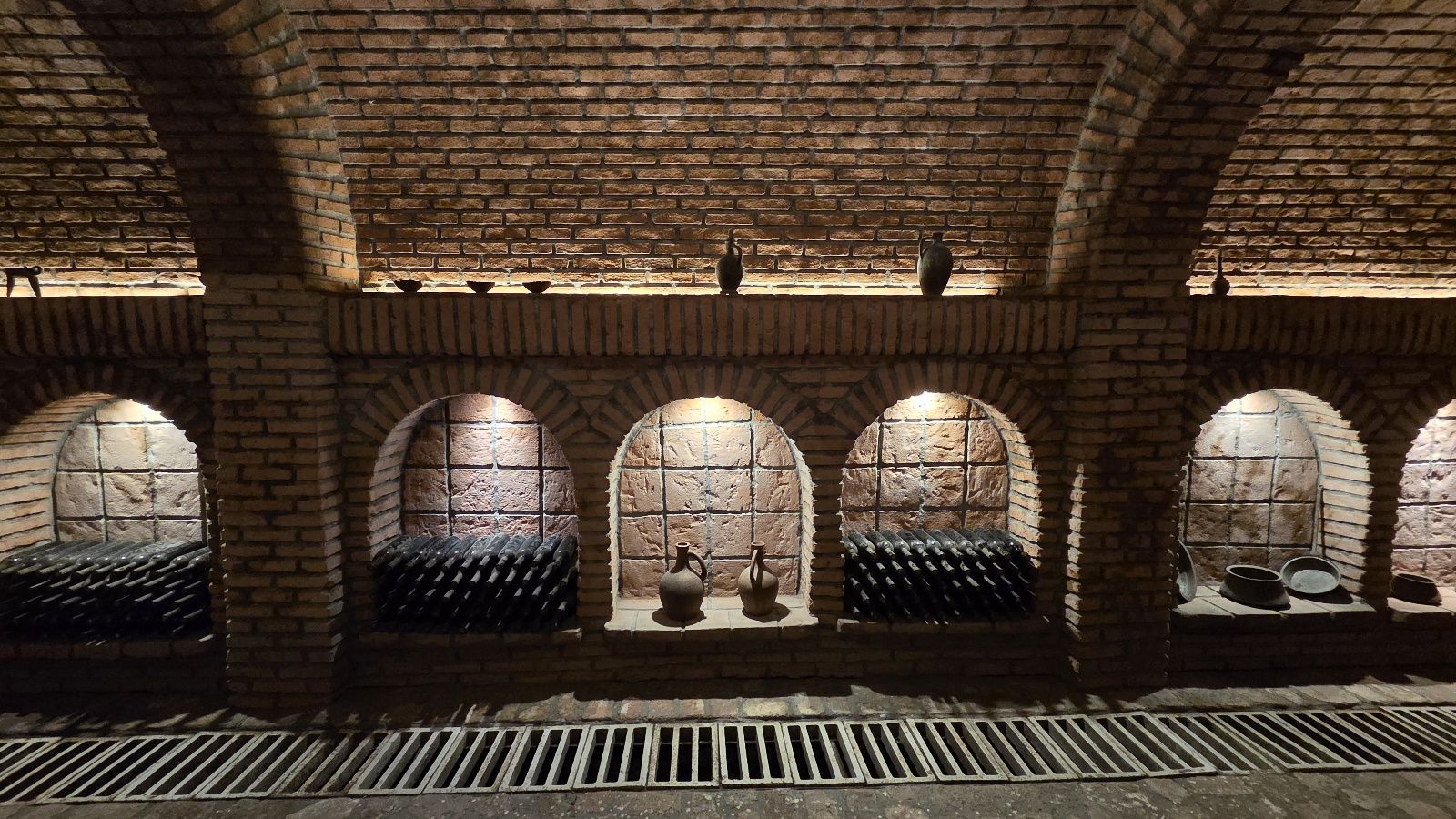
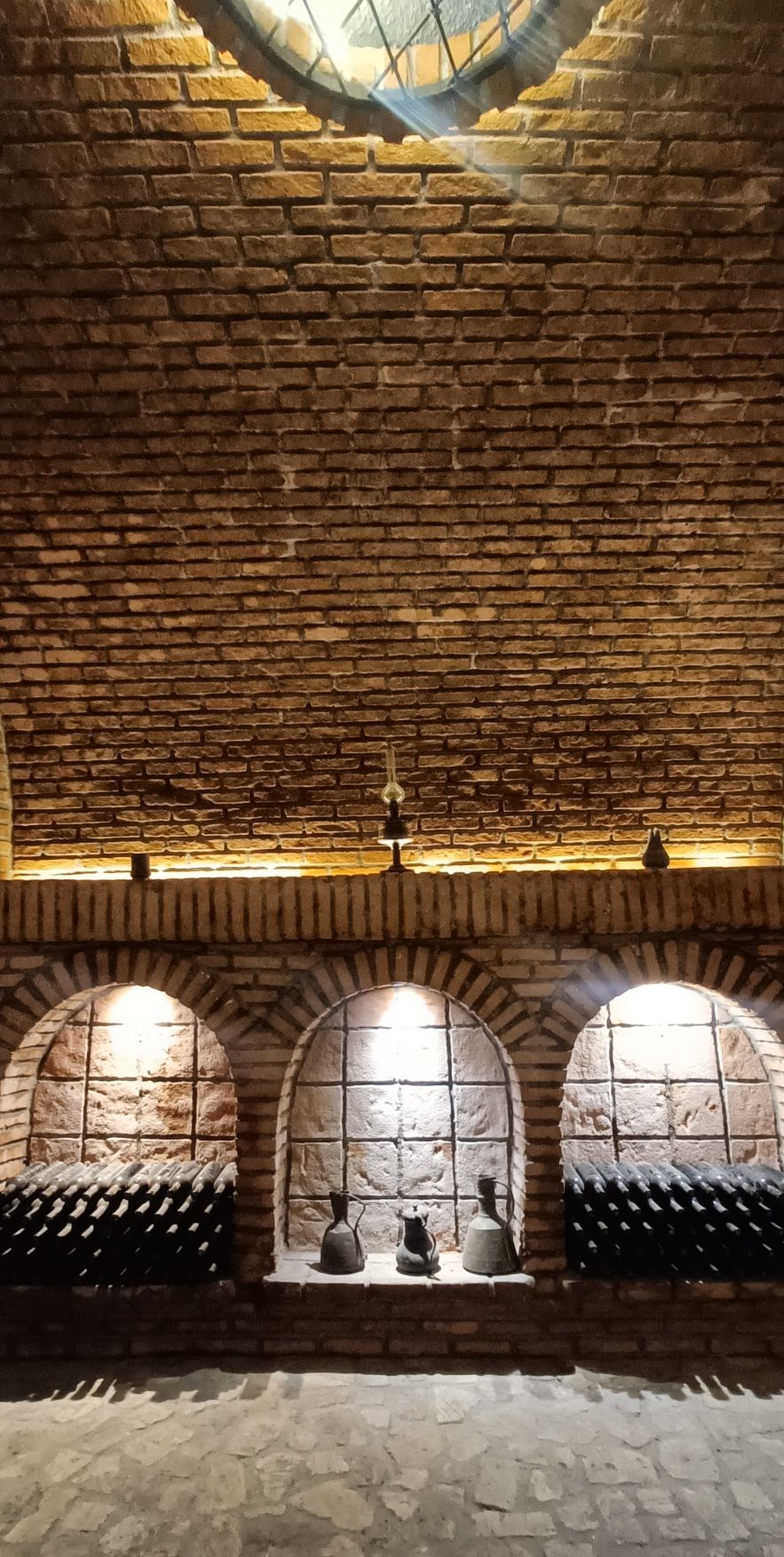
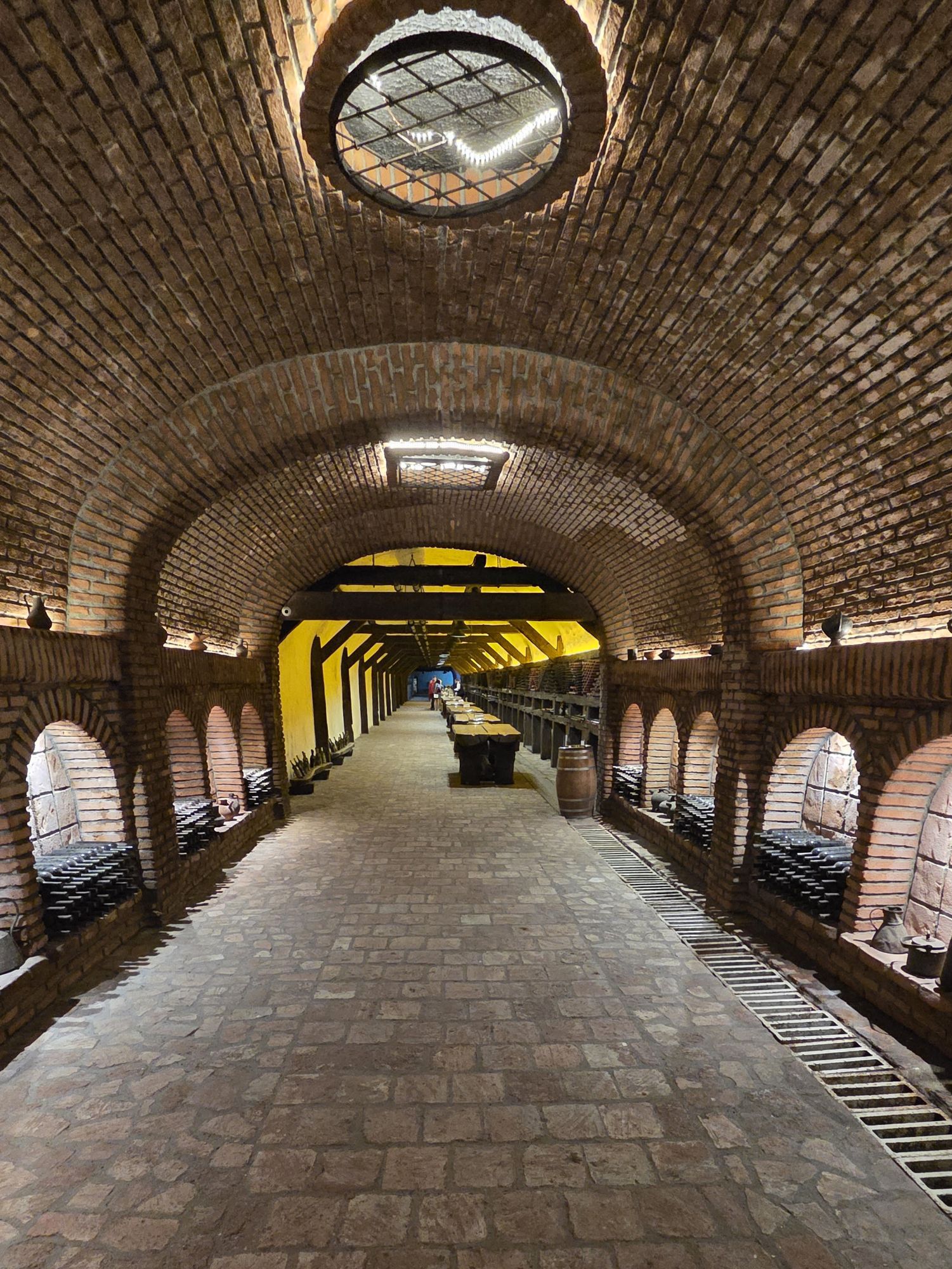
The tunnel runs along a brick wall on one side and floor-to-ceiling wine bottles on the other, lit by warm yellow lights that make the whole space feel like something between a wine cellar and a very dramatic corridor.
The bottles are stacked at angles in carved-in shelves, thousands of them, and the sheer quantity of it, the scale of the operation, becomes clear only when you’re standing inside it.
Our guide walked us through the history. Wine-making in Kakheti started as a household practice, she explained, before becoming a profession and eventually an industry.
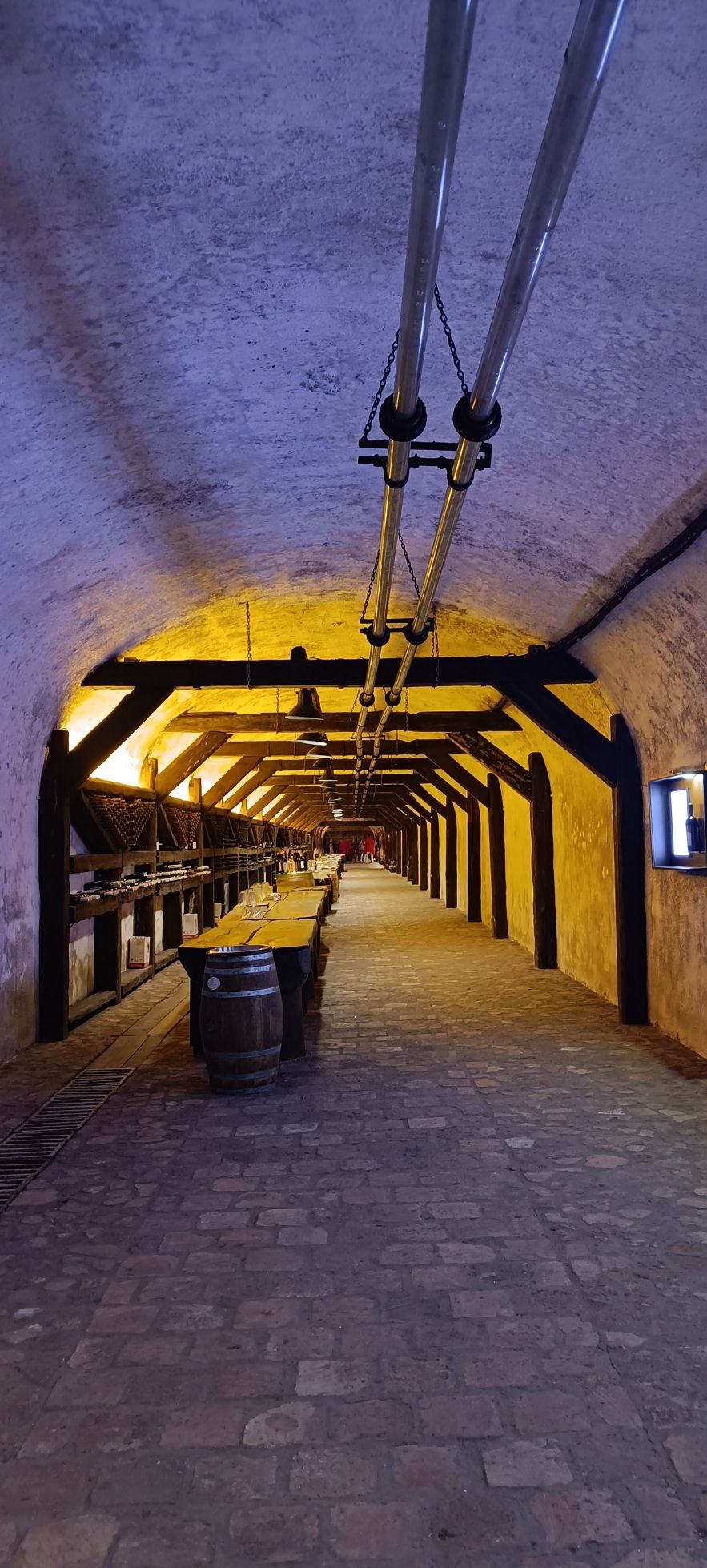
She showed us the older equipment still kept in the tunnel, large wooden barrels used for crushing in earlier years, and a wide semi-circular wooden structure, like a cross-section of an enormous tree trunk, that was used for traditional stomping before modern methods arrived.
The tunnel also displayed various awards the winery has received, and samples of the grapeseed oil they produce — one of their less-famous but genuinely interesting products.
A note on prices: The wines and oils sold here are more expensive than what you’ll find in Tbilisi’s markets or smaller local shops. If you want to buy Georgian wine to bring home, compare prices before purchasing here.
If I didn’t know it was a winery tunnel, it was so well-maintained that it looked like a foyer or a corridor of a boutique resort.
The cold crept in more as we turned to the award section, and she showed us the old pictures of the winery and how everything that was done traditionally has been preserved, though new methods are now used.
The Vineyard: Harder Than It Looks
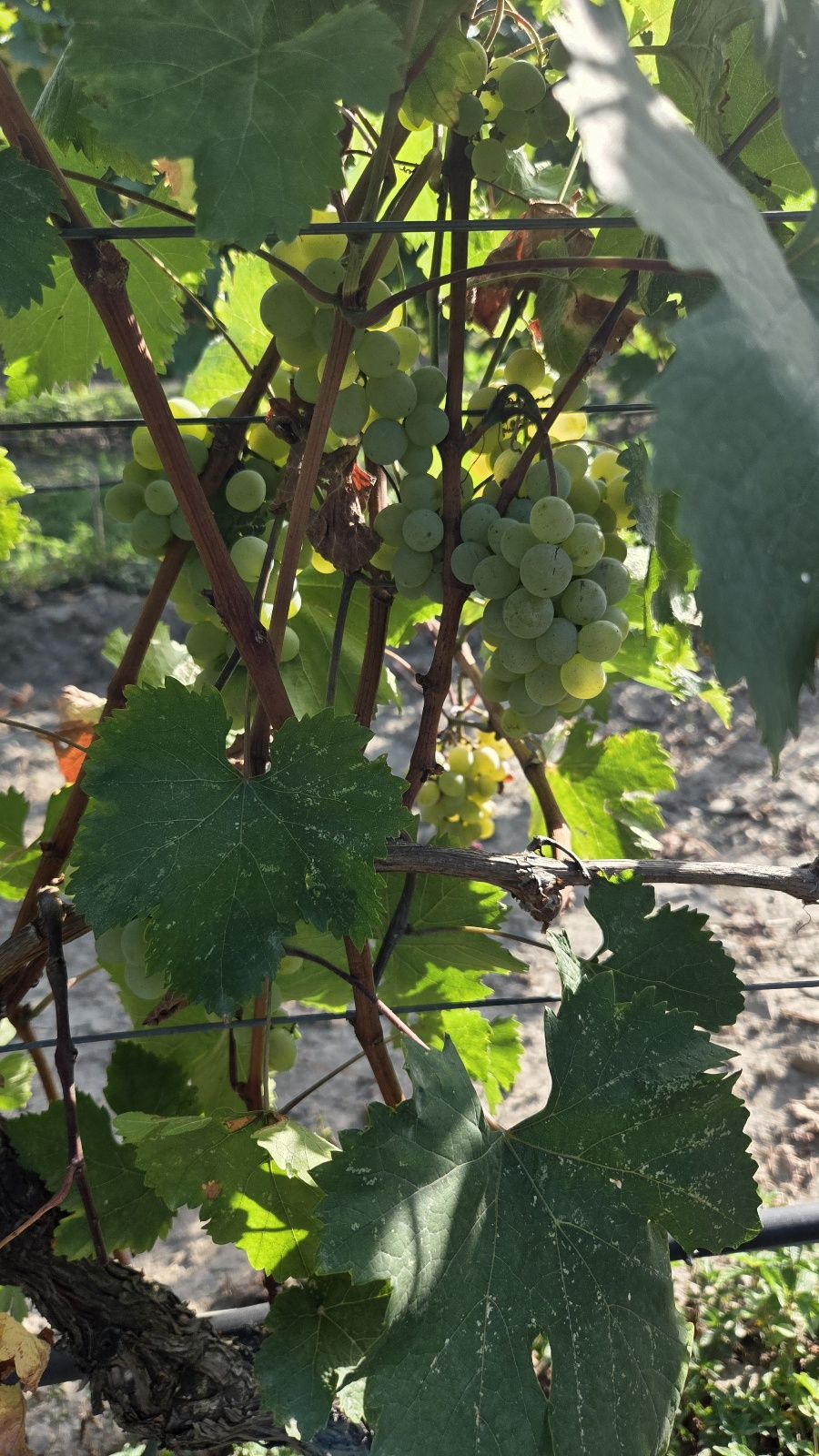
After the tunnel tour, while other guests moved to the wine tasting, our guide took us by golf cart to the adjacent vineyard.
The vineyard stretches across many hectares. The grapes hung in bunches just within reach, exactly as you’d imagine from a photograph.
She handed us a pair of garden scissors and a plastic bucket and told us to fill it with grape bunches.

It sounds simple. It is not.
The leaves kept getting in the way. The stems the bunches hung from were positioned awkwardly, often tucked under leaves or angled so that when you cut them, the bunch fell to the floor rather than into your hand.
More than once, I lost a bunch of stuff to the ground and had to decide whether to pick it up. And because you have to bend down to pick from the bottom branches, it was tiring as well.
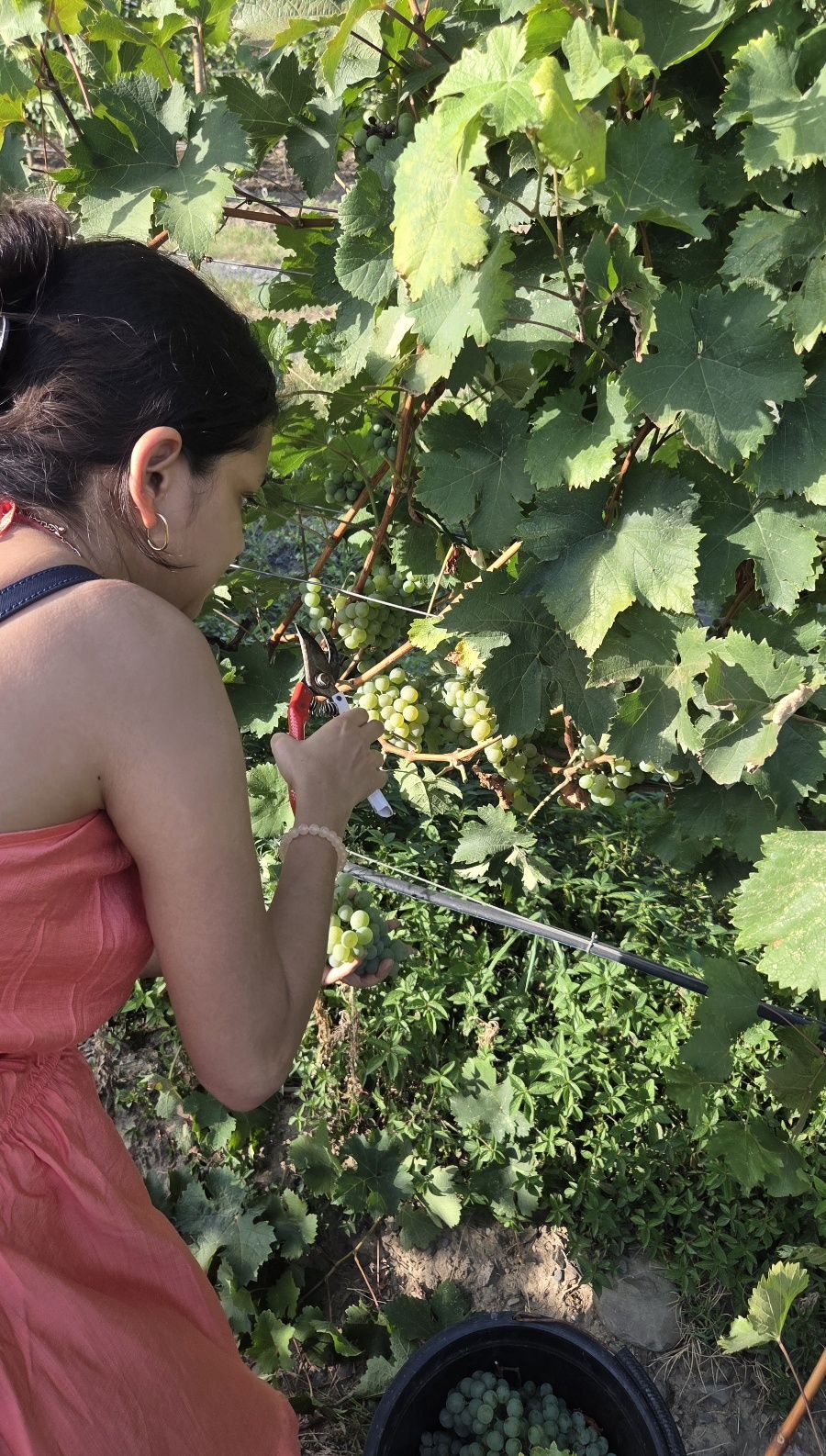
At some point, our guide observed that the workers fill hundreds of such buckets per day, and that the winery trains people to do it efficiently, while we had, in her words, been paid to do their job. I would be lying if I said I was not offended by her insensitive comment.
She was studying to become a wine producer, in her second year, and it was amusing and rather interesting to me that such a profession exists and we are unaware of it.
I wondered, how would it feel to be a wine producer at the age of 25?
Somehow, I finished filling the bucket, and we loaded everything back onto the golf cart.
The Grape Stomping: The Moment the Whole Trip Was Worth It
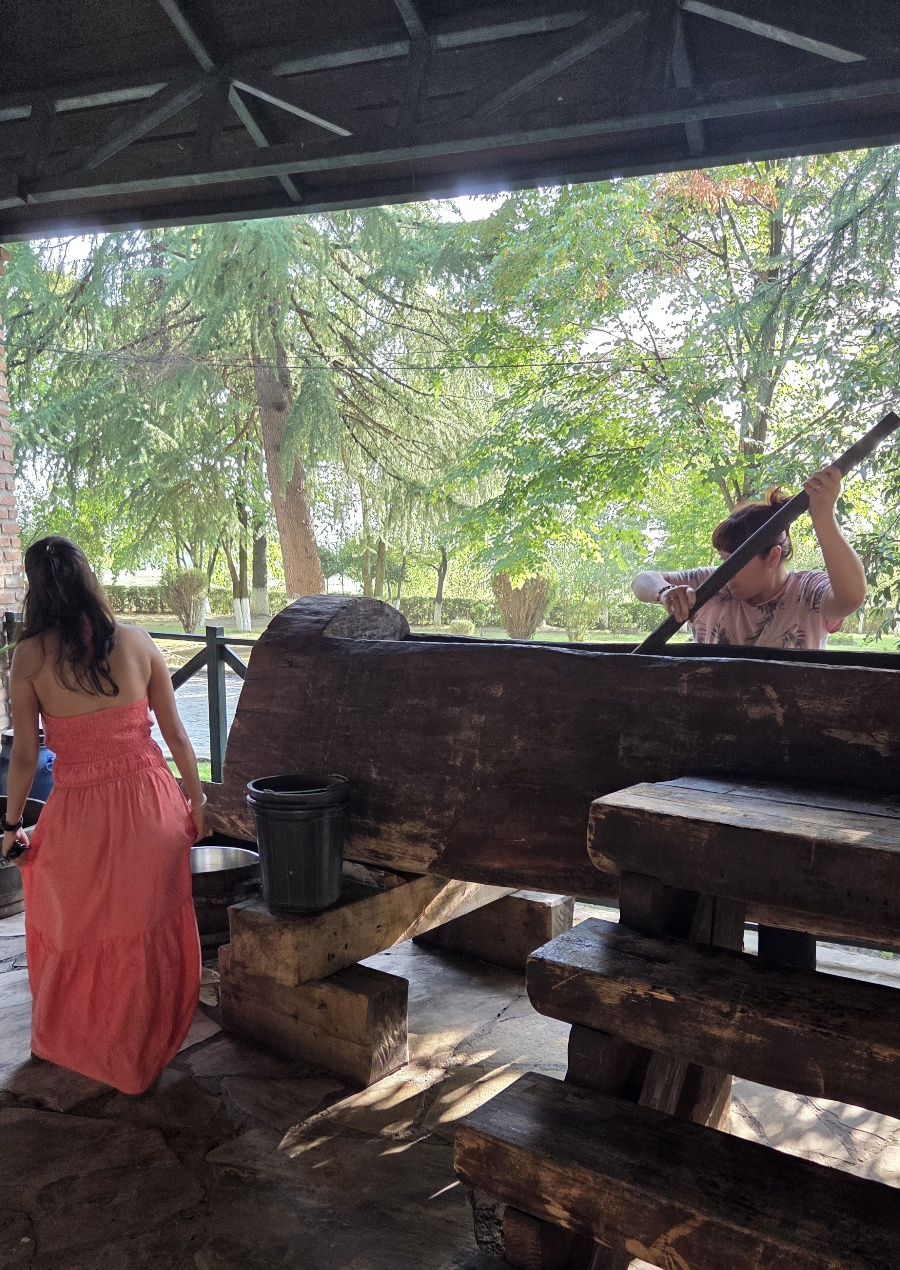
A little further along, we were taken to a large open area where a wooden container was kept on a pedestal. The container was shaped like a cross-section of a massive tree trunk, laid horizontally. A worker poured our entire bucket of grapes into it.
We were given rubber boots to wear over plastic bags to get ready for the stomping.
And then, while we were still trying not to fall over the grapes with our huge rubber boots on our feet, a group of singers appeared nearby.
Four or five men, dressed in traditional Georgian ceremonial clothes, the distinctive black coats with ornate buttons, began singing a traditional song of grape crushing.
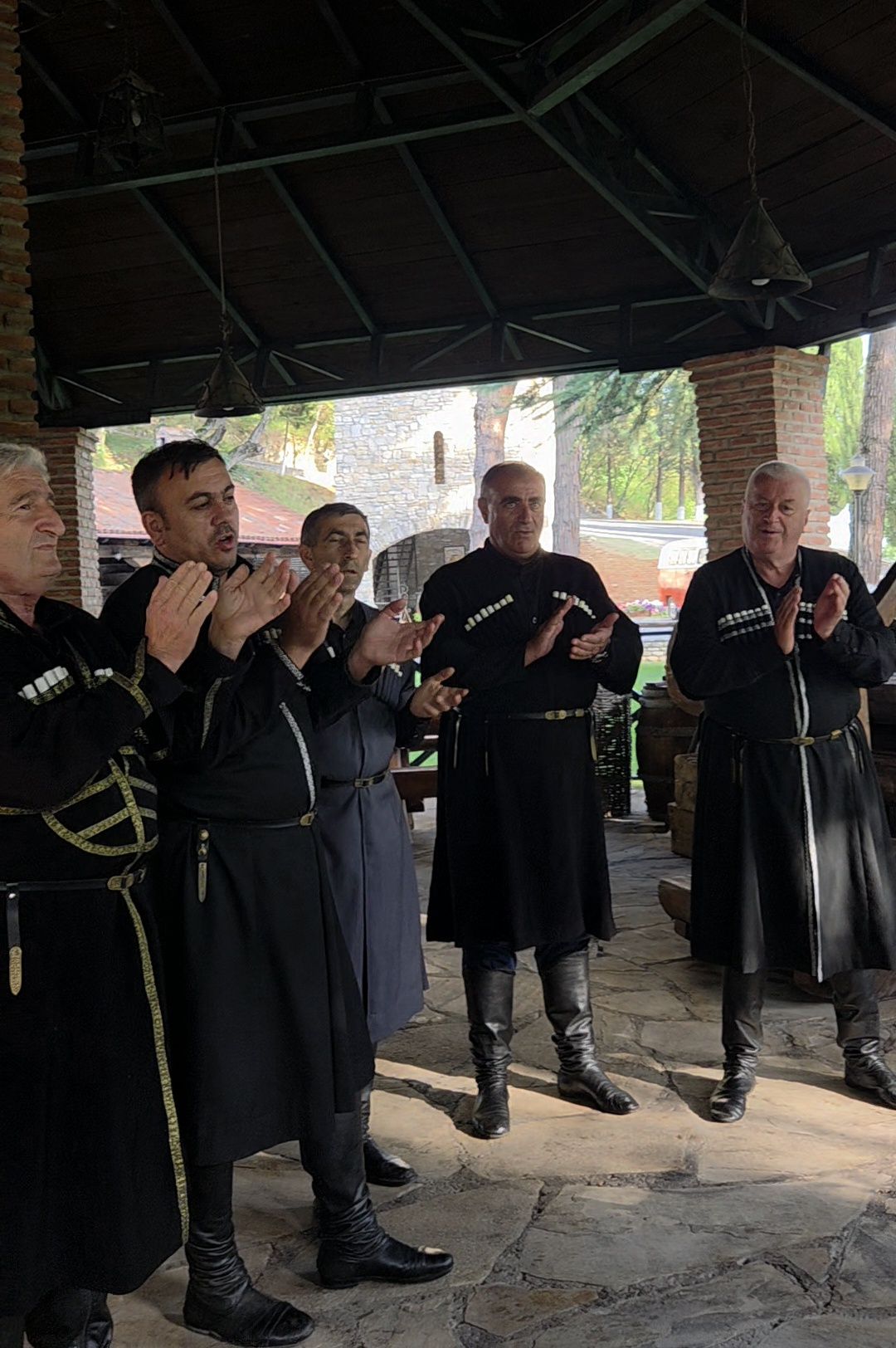
Our guide told us that it was a ritual that has accompanied the harvest in Kakheti for centuries. The same song, or something very close to it, was sung when this was not a tourist experience but simply how wine was made.
Standing in that barrel, with grape juice running out through the opening at the base, with traditional singers performing beside me, I felt genuinely, unexpectedly joyful. It felt like the best experience.
I had watched grape stomping on television and social media for years.
It always looked like the kind of thing that looked so exciting and fun. And it was indeed fun, especially the satisfaction of crushing 3 buckets of grapes into grape juice, which would turn into a real wine.
Our guide told us that nothing from the crushing is wasted.

The juice was taken immediately for fermentation, and she mentioned they start the process within minutes of stomping to preserve the quality.
We left Winery Khareba happy and content. All the mild disappointment of the morning, the heat, the expensive tour guide at Sighnaghi, and the struggle with the grape scissors had been replaced by something lighter after this Georgia wine experience.
Practical Information: Everything You Need to Know About Winery Khareba
Options and prices:
| Experience | Duration | Price |
|---|---|---|
| Tunnel tour | ~45 minutes | 10 GEL |
| Wine tasting | ~30 minutes | 35 GEL |
| Grape stomping / wine making | ~1 hour | 50 GEL |
Our recommendation: Skip the wine tasting if you’ve done it elsewhere, unless you plan to buy wines from Georgia. Do the tunnel tour and the grape stomping, together they give you the full experience for 60 GEL per person.
Book in advance: Yes, especially during the September and October harvest season.
How to get there: Winery Khareba is in Kvareli, Kakheti. From Telavi, approximately 30 minutes by car. From Tbilisi, approximately 2.5 hours.
What to wear: Comfortable clothes you don’t mind getting grape juice on. Closed-toe shoes, you’ll be changing into rubber boots for the stomping, but you’ll be walking vineyards beforehand. Avoid long dresses if possible; they get in the way during grape picking. Learn from my experience.
For non-drinkers: Completely worth visiting. The tunnel tour, vineyard walk, grape stomping, and traditional singing have nothing to do with how much you drink.
Photography: The tunnel has excellent natural warm lighting and is one of the most photogenic spaces in Kakheti. The grape stomping is extremely photogenic. Bring your camera or make sure your phone is charged.
How to book: You can book through their official website or book a guided tour from Tbilisi.
Is Winery Khareba Worth It?
Yes, with honest caveats.
It is a commercial operation, and it feels like one. The golf carts, the organised pricing tiers, the gift shop with wine that costs more than in Tbilisi, none of this is hidden.
If you want an intimate family winery experience, this is not that. If you want a family-run winery experience, you can book a guided tour like this.
But the grape stomping with traditional singers is genuinely extraordinary.
For Indian travellers visiting Kakheti, this is the experience I’d most recommend. It is accessible, it is visually stunning, it doesn’t require you to drink, and it gives you a story worth telling.
At approximately ₹2,000 per person for the tunnel and stomping combined, this is one of the most affordable memorable experiences you’ll have in Georgia
Ready to book? Check availability here for the Winery Khareba experience.
Visiting Kakheti? Read our complete Kakheti travel guide — including Alaverdi Monastery, Sighnaghi, and the Lagodekhi trek.
Planning your full Georgia trip? Here’s our 10-day Georgia itinerary.
Questions About Winery Khareba
How much does Winery Khareba cost?
The tunnel tour is 10 GEL, the wine tasting is 35 GEL, and the grape stomping experience is 50 GEL per person. Budget an extra 5–10 GEL for water and small purchases on site. They also have an in-house tour package costing 145 GEL.
Do I need to book Winery Khareba in advance?
Yes, especially in September and October during harvest season when slots fill quickly.
Is Winery Khareba worth it for non-drinkers?
Yes. The tunnel tour and grape stomping experience have nothing to do with drinking. The grape stomping with traditional Georgian singers is genuinely memorable regardless of your relationship with wine.
What is the grape stomping experience like at Winery Khareba?
You pick grapes in the vineyard, carry them to a traditional wooden stomping container, put on rubber boots, and stomp the grapes while traditional Georgian singers perform the ceremonial harvest song beside you. It takes approximately an hour, including the vineyard walk.
How do I get to Winery Khareba from Tbilisi?
Approximately 2.5 hours by car. A private driver is the most comfortable option (check availability here). The winery is in Kvareli, Kakheti, not easily accessible by public transport.
How do I get to Winery Khareba from Telavi?
Approximately 30 minutes by car. Most visitors staying in Telavi combine the winery with Sighnaghi and Alaverdi in a single day.
What should I wear to Winery Khareba?
Comfortable clothes you don’t mind getting slightly dirty or stained. Closed-toe shoes for the vineyard walk. You’ll change into rubber boots for the stomping. Avoid long dresses; they can make grape picking difficult.
Is the wine at Winery Khareba expensive?
Yes, you can find them more expensive than wines in Tbilisi markets or smaller local shops. Compare prices before buying if you’re planning to take wine home.
Discover more from The Hopping Tales Journal
Subscribe to get the latest posts sent to your email.
Leave a Reply